


Over recent years, professional services firms have continued to invest heavily in learning and development. In a more demanding economic environment, however, attention has shifted firmly towards impact. What increasingly matters is whether learning leads to real behavioural change, stronger performance and measurable commercial outcomes.
A fresh white paper from The Results Consultancy
This is why The Results Consultancy team has updated its white paper, Making training stick in professional services firms for 2026. First published in 2017, the paper has been refreshed to reflect today’s:
- hybrid working patterns
- digital learning environments and
- growing expectations around inclusion, wellbeing and retention.
It has been rewritten for firms that want learning to deliver tangible results, not just positive feedback. In developing the paper, we have drawn on current research with senior L&D, Talent and People teams, as well as our client experience research and observations of modern best practices across the professional services sector.
Who we wrote the white paper for
The paper is written for those across professional services firms who are focused on driving performance, growth and results in 2026 and beyond. It will be particularly relevant for senior leadership teams and those responsible for learning, talent, leadership, and professional development.
It is also aimed at professionals who commission external programmes, including those working in HR, L&D, business development and client development. For them, the paper shares ideas to help build greater confidence that the learning investment is directly supporting the outcomes their firms and teams seek.
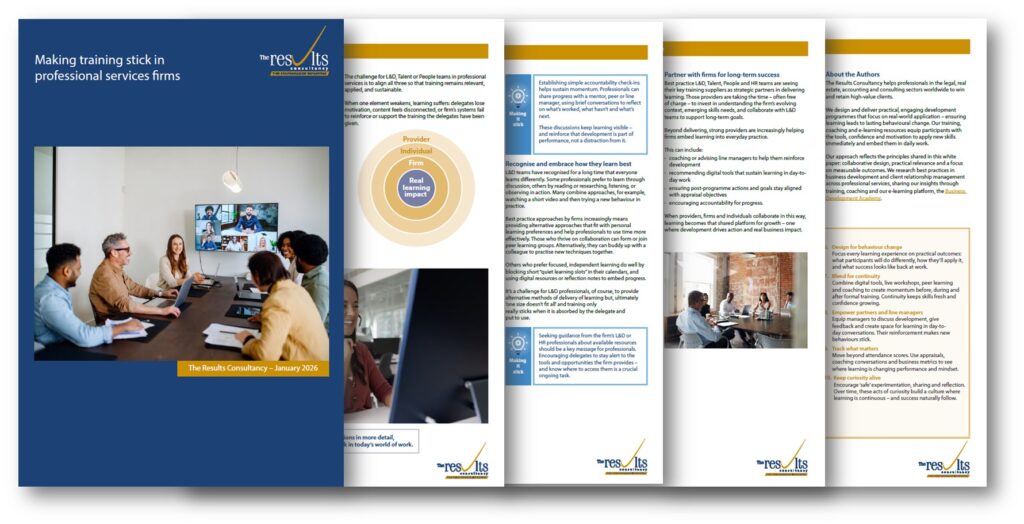
For your complimentary copy, email: results@winningbusiness.net
6 key points from Making Training Stick
1_Why making training stick matters more than ever
The way professionals learn has changed significantly in recent years. Hybrid working and online platforms have made learning more accessible, but they have also made it easier to fragment, postpone or forget. At the same time, firms are under pressure to retain talent and build cultures where people feel supported and able to perform at their best.
In this context, effective training is not simply defined by the quality of the event itself. It is also shaped by what happens before and after. Clarity of purpose, relevance to real work and consistent reinforcement all play a critical role in whether learning translates into lasting change.
2_Moving from training programmes to learning ecosystems
A central theme of the 2026 white paper is that training which truly sticks is a shared responsibility. It relies on three contributors working together.
- The firm sets the context through clear commercial goals. Training is supported by leadership behaviour, culture and systems that value development.
- Individuals take responsibility for applying learning and building new habits.
- Learning providers design programmes that focus on real-world application to support the commercial goals, and help with ongoing reinforcement.
When these elements are aligned, learning becomes part of day-to-day work rather than something that sits alongside it.
3_What firms can do to create the conditions for lasting learning
As you’d expect from The Results Consultancy, our white paper outlines practical steps to help firms improve learning transfer and return on investment. There are examples of current best practices and implementable ideas.
A key theme is for firms to position learning as a strategic enabler that is clearly linked to commercial priorities. When professionals understand how development supports both firm performance and their own progression, engagement increases and learning time feels justified.
We’ve also addressed one of the most common barriers in professional services: lack of time. In many cases, time is not absent but unprotected in busy schedules. Firms making progress are taking a more realistic approach, for example, through short learning sprints, structured reflection, and project debriefs that support learning and experience without undermining client delivery.
Reinforcement is another critical factor. Learning sticks when it is noticed and valued in the firm, and we’ve shared practical examples of what’s working well.
4_What individuals can do to turn learning into an advantage
Even in supportive learning cultures, training only embeds when individuals take action. In our white paper, we’ve therefore highlighted what high-impact learners tend to do differently.
In summary, our research shows that they link learning to their current work and personal goals. For example, they adopt new ideas quickly, seek feedback and reflect on what is effective. Over time, they establish small routines that maintain momentum. Impactful development seldom arises from dramatic changes. It is usually the result of consistent, small adjustments that accumulate over time.
5_What providers can do to design for behaviour change
For learning providers, the starting point is not just content but intent. Our paper examines the effect of designing learning based on what participants need to do differently in their roles, rather than what they need to know.
We also explore why one-off interventions don’t necessarily change behaviour, and how learning sticks more when it is designed as a connected journey. ‘Connected’ in this context means supported by reinforcement, sponsorship and real work application.
Measurement matters too, and we’ve shared alternatives to attendance numbers and satisfaction scores. We’ve also explored how providers and firms can assess whether learning is genuinely being applied and making a difference.
6_Ten practical takeaways for firms
In writing the white paper, we wanted it to be highly practical. That is why we’ve ended with 10 actionable takeaways. These will help firms create an environment where learning does indeed stick, and their investment can generate the return they seek.
Access your copy
To receive a complimentary copy of Making training stick in professional services firms, email: results@winningbusiness.net
For further information about our range of practical training, coaching and development solutions that enable learning to stick, please contact John Timperley, Managing Director at The Results Consultancy on:
E: results@winningbusiness.net
T: +44 (0) 20 7488 4419
Or via our contact form